How Effective SEO Can Help Your Small Business

SEO stands for search engine optimization, an integral process to building and maintaining your online presence as a small business. In simple terms, optimizing for search engines means making sure that your website has relevant and quality content. The right kind of content helps search engines like Google index your site and display it to people who will likely be interested in your services and what you have to say. Effective SEO brings potential customers to your site for the right reasons. So how can effective SEO help your small business? There are many benefits of SEO, but for the sake of brevity we can boil these down to three major advantages – especially for small businesses.

Effective SEO Can Help Save Your Small Business Money

One of the biggest direct costs that small businesses struggle to contend with is marketing. Small businesses want to market either to a select demographic or their local community. Most small businesses depend on word of mouth to gain and keep customers, but sometimes this is not quite enough. That is where marketing comes in. Unfortunately, marketing costs can add up quickly even for the most well established small enterprises. Optimizing your website for search engines can help you save money in this area. The most effective SEO brings in leads and potential customers from their search queries – one specific form of in-bound marketing. Most importantly, it is very cost-effective when compared to other forms of direct marketing. 

Effective SEO Can Keep Your Small Business Competitive

The vast majority of people are now online, with a significant portion accessing the Internet each and every day. As a result, effective SEO is crucial for keeping your small business competitive. It is likely that your competitors are also engaging in search engine optimization, which means that you need to act on SEO as soon as possible to ensure that your business shows up alongside the competition. Effective SEO for small businesses does not have to be complicated. In its simplest, it helps ensure that consumers interested in what you do will easily be able to find you online.

Effective SEO Can Help You Grow Your Small Business

When done right, search engine optimization does more than serve as a cost saving measure or a means to stay afloat in the midst of the competition. Instead, effective SEO can actually grow a small business. Optimizing for search engines can often bring in new leads and create new customers in people who only found your business online. Google provides several powerful tools for identifying new market segments, keywords that potential customers are using, and insight on what content form is most effective for your small business. Of course, at the center of this growth is your business website. Effective SEO is dependent on bringing leads to an engaging and dynamic website, which means that building a great website should be a small business owner’s first priority. After that, search engine optimization can help bring people into the business.

How to Outsource All of Your Web Design Needs

When it comes to outsourcing web design for small businesses, many business owners have a hard time knowing where to begin. We are here to help with that. There is no question about it: outsourcing the work that goes into maintaining your small business’ web presence can save you both time and money in the long run. Of course, getting started on the process can be a little intimidating for many business owners, particularly if they do not have much experience with WordPress or with Internet technology in general. There are at least three key considerations when you begin the process of outsourcing your web design needs and website updates.

Tip #1: Consider Your Business Needs Before Beginning

The first step to outsourcing web design and website updates is to sit down and ask yourself what you are looking for. Do you need an entire website built from scratch, or just a change to a specific page? Will you need continual support on a lead generating website, or a few updates each month to static web pages? The answers to these questions will determine which kind of service you look for when you outsource all of your web design needs. Some companies offer full service packages, covering your bases when it comes to everything from search engine optimization to the design of a website from scratch. Others (and especially freelancers) will specialize in making specific requested changes to your small business site as the need arises. The key to outsourcing website updates and even web design is to know what your needs are ahead of time in order to avoid putting the cart ahead of the horse.

Tip #2: Get Someone Who Knows More About WordPress Than You Do

This may seem to be a no-brainer, but it is nevertheless an important point. Even if you know a great deal about web design and are looking to outsource simply to save time, getting someone more knowledgeable than yourself will most likely turn out to be a lifesaver at some point. Rather than needing to continually follow up with the person you have hired to make updates, getting someone who knows more about WordPress than you do means they have both the skill and experience to get what you are looking for done with minimal feedback and direction. Accept nothing less than a WordPress expert. Outsourcing is a balance of saving both time and money – putting a little bit more money in at the outset will help save you time down the road.

Tip #3: Take the Time to Find the Best Option for Your Business

With the Internet such an integral part of daily life, there are hundreds of different companies and thousands of individual freelancers that offer web design and web maintenance services. With the abundance of results that a quick Google search returns, it can seem overwhelming to find just one that fits your business needs. However, taking a couple of extra hours to look at samples, request references, and even email back and forth a bit to consider communication and customer service will save you quite a bit of time in the long run. Expertise is not the only aspect to consider when you are looking for freelance help with your small business website; open and clear communication will prove just as important.

If you have any follow up questions about how to outsource all of your web design needs, feel free to contact us today!

5 Reasons to Have a Responsive Web Design

The idea of creating a responsive web design for your small business site may seem a little daunting at first. But there are plenty of reasons that a responsive website is worth the investment. As Internet technologies grow exponentially, mobile usage has exploded at the same time. This means that more and more Internet users – and potential customers – are using their smartphones rather than a desktop computer to access social media and websites. In simple terms, responsive web design means creating a website that automatically changes its format depending on the device – from a PC desktop to a smartphone, responsive websites do just that: respond. This opens up a unique opportunity for the average small business owner to create a responsive WordPress site.

Reason #1: Responsive Web Design Means a Better User Experience Means More Customers

First impressions are everything, even when it comes to designing and maintaining a great website for your small business. Keeping a responsive web design means that if someone accesses your website from their laptop or smartphone, they will have the same straightforward experience. The easier information and services are accessed on your website, the more leads and customers you will generate.

Reason #2: Responsive Web Design Lets You Target an Audience on Mobile

Today, more than half of website traffic around the world is from mobile devices like smartphones. Taking the time to build a responsive website can quickly translate into a wider audience base. If someone comes to your website on a mobile phone and it is difficult to navigate, they may quickly navigate away. A responsive WordPress site helps encourage potential customers to stay on your website for longer.

Reason #3: Responsive Web Design Ranks You Higher on Google

There is no question about it – having a website that responds across multiple devices directly translates into a higher ranking on search engines like Google. Search engine optimization is the name of the game these days, and having a single URL for your website gives you a better ranking – particularly on Google. The long and short of it is that a responsive site can easily give you an edge over your competition when it comes to inbound traffic.

Reason #4: Responsive Web Design Means Managing One Website for Difference Devices

 While creating a site for different devices may sound more complicated at the outset, a responsive webpage can actually save a great deal of time in the long run. Having just one responsive website means that it is the only site that you will need to manage and update consistently. Not only that, but having just one site also directly reduces the cost associated with having a web presence, directly resulting in a higher return on investment.

Reason #5: Responsive Web Design Utilizes A Reciprocal Relationship Between Mobile Websites and Social Media

People regularly access websites through social media rather than search engines, and more people are using social media everyday. Since a great deal of social media activity happens on an Android or an iPhone, you will want to be sure that there is a seamless transition between your business’ social media page and your business website. This is where investing in a responsive WordPress site comes in.

Analysis Paralysis and the Power of WordPress

Don’t forget, WordPress is a CMS.

It strikes us as somewhat ironic that many business owners who own WordPress websites seem to forget that WordPress is a content management system. Put differently, a lot of WordPress website owners seem to forget what it means that their site is built on a CMS.

They think that if they change their service offerings, they need a new site.

They think if they get a new logo, they need an entirely new site.

They think that if the site starts to look old and outdated, it needs to be rebuilt “from the ground up.”

Which ground isn’t entirely clear.

But, because these “projects” seem big and complicated, the “project” is put off for months or years because it seems so daunting. It’s classic analysis paralysis. From Wikipedia:

A decision can be treated as over-complicated, with too many detailed options, so that a choice is never made, rather than try something and change if a major problem arises.

The proof is everywhere: just look at all the old, dusty WordPress sites out there. Why would someone let their website get so outdated? Maybe it’s partially because they think their site is hard-coded and stored in a vault somewhere. While the DIY’ers of the world are familiar with the WordPress community’s superabundance of plugins and themes, site-owners don’t often take advantage of WordPress’s enormous potential. And we believe the reason for this, more often than not, is the fear of finding, committing to, and paying a new contractor to tackle the “project.”

We believe these site owners shouldn’t have to find a contractor at all; instead, what they need is an easy-to-use service that will help them take advantage of the site they already have. They need a way to request a task and quickly see the results. They need a system that, with few taps, lets them try on a new theme, or have their plugins updated. They need to easily preview changes without going live.

At HubRunner, we’re building a product that does all of the above. They keys are ease-of-use, instant service, and low prices.

If you’ve got an old clunker in the cloud, get the HubRunner app. Your site may be a classic sports car under the rust, and restoring it will cost a lot less than you might think.

Dynamic Skill Matching for WordPress Service

We decided this post needed an impressive title, so we settled on ^^^ that. But really, we’re just talking about finding the right contractor.

THE PROBLEM

Finding someone to work on your website sucks.

Anyone who’s used a freelancer marketplace knows how painful the process can be. Anyone who’s ever sent out an RFP for a website project really knows it.

Even with the best available tools like UpWork, it’s still a tedious and time consuming process.

Beyond all the pitfalls of searching for the right person, once you’ve made your choice you may find your contractor doesn’t communicate well, or can’t do what they said they could. They might be delays if they spend more time on another project that’s paying them more. You might end up spending more than you expected. You might not get the project completed, and instead have to go find another contractor.

The old world of website service is insanely inefficient, where service providers prey on people’s lack of technical and practical knowledge about websites. (Frankly, this is true for most tech and IT-related services – but for now, we’re focused on websites).

The end-user experience of getting a website – or getting something done to an existing website – is absolutely abysmal. From buying a domain to launching a site, we’d be hard pressed to figure out how the experience could possibly be any worse.

This is why we all love referrals. We love them because another person, someone we know and trust, has gone through the painful and often expensive process of finding and vetting a given contractor. The contractor comes to us already-tested, both as a professional and as a human being. The contractor still might not be the perfect person for the job, but at least there’s an element of trust and a track record of positive results.

As our team began to face the many challenges of creating a two-way marketplace for WordPress service, we knew that the agent vetting process needed to be done on our end. Website owners shouldn’t vet their own service providers, for many reasons (lack of technical knowledge, lack of time, lack of negotiating skills, etc.).

Instead, our software completely eliminates the need to look for a contractor.

DYNAMIC SKILL MATCHING

Agents on HubRunner are WordPress professionals with only the best work experience and service quality. We constantly improve the experience of using HubRunner by tracking their work and the ratings that you, the users, give them.

But our software goes one step beyond this.

We not only vet agents on their work history, we vet them on very specific types of work, on granular capabilities. Then, we work hard to ensure that agents only see requests that fit their HubRunner capabilities profile. This means that an SEO-related request will only be offered to agents with an expert knowledge of SEO. A request about slow page-load times can only be claimed by an agent with expertise in that area.

It’s kind of like online dating, but without the smiling vacation photos – and without the dates.

Password Mania vs. Temporary Site Access for WordPress

Passwords are a necessary … hassle … when it comes to managing a website. Your site has to be secure, but it’s a pain to store, use and share passwords. Sure, there are some great systems (like LastPass) that help, but we’re dealing with lots of passwords, and we really prefer not to see anyone else’s credentials.

THE OLD DAYS

When providing website service, obtaining a customer’s website login credentials is the first task. In the old days (i.e., through 2015), it served as a token of trust in a business relationship. But it involved a lot of unpleasantness:

– Creating (and paying good money for) password management accounts for lots of users
– Training users on how to manage passwords (rules, organization, etc.)
– Managing administrative access to the password retrieval inbox
– Notifying users if login credentials were updated.
– And on, and on, etc.

Oftentimes, finding and using login credentials took more time than actually providing the service that had been requested. And on top of all that, it meant that anyone who provided service could retain the credentials forever, and could access the site as long as the user account wasn’t deleted from the site backend.

Exhausting, right? We called it password mania.

A BETTER WAY

When it came to developing our own software for an on-demand WordPress support network, we knew we needed an elegant solution to the password mania problem.

After months of development, our software was really coming together, feeling cohesive and efficient. We knew that sending login credentials to a third party really should be a thing of the past. We believed the solution was a time-based website access system which would:

1. Enable a pre-approved WordPress agent to access a website when they claim a service request
2. Function without the agent ever seeing or entering the login credentials
3. Revoke website access immediately upon completion of a service request

Temporary site access for WordPress is just one of the features that makes HubRunner what it is – but in a sense, it’s the glue. HubRunner grants website access to an agent only for the duration of the work they are handling on that site. As soon as the user indicates the agent has completed a request to their satisfaction, the agent’s site access is revoked.

All of this happens without the agent ever seeing or entering your credentials. Beyond simply enhancing the smooth experience of using HubRunner for WordPress service, this feature increases security, creates a seamless way for agents to deliver service, and reduces the total time for each service request.

To learn more about how HubRunner matches customers to agents, read our post “Dynamic Skill Matching for WordPress Service.”

The Goldilocks Dilemma for Subscription Services

I recently came across a new subscription service founded by the self-described “inventors of the revolutionary sockscription.” Yes, they deliver fresh socks to your doorstep every month.

There are officially subscriptions for every type of product and service. Music, movies, razors, clothing, vegetables, social media management, website service, valet parking, prepared meals – everything.

But there is a major problem with some of these subscription services, one we might go ahead and call the Goldilocks dilemma.

WHY SO MANY SUBSCRIPTIONS?

Those of us who either work in, or subscribe to, these types of services (Software-as-a-service, Marketing-as-a-service, Socks-as-a-service, Razors-as-a-service, etc.) are well versed in the terminology of the subscription economy:

One the consumer side, we hear phrases like: Month-to-Month; No contract; Cancel at any time; One low monthly fee.

As providers of these services, we talk about: Productized service; Recurring revenue (Monthly, Annualized, etc.); Scalability; Churn; Customer lifetime value; Customer acquisition cost; Et cetera, etc.

In reality, most subscriptions are product-and-service combinations with business models that rely on one key input: recurring revenue that rolls in by charging subscribers’ credit cards or bank accounts each month.

Consumers are drawn to subscriptions because they offer cost control, elegant user experiences, and long lists of features (some high value, some not-so-high value). Service providers yearn to create subscriptions because they offer the predictability of recurring revenue. But in order to efficiently run and market a subscription service, all sorts of constraints must be placed on the product – and therein lies the Goldilocks dilemma.

THE GOLDILOCKS DILEMMA

Across diverse fields from cognitive science and astrobiology to economics and pricing, the Goldilocks principle refers to something that falls within some reasonable margins instead of being at either extreme (“This porridge is too hot…this porridge is too cold…ahhhh, this porridge is just right!”). In short, we are all like Goldilocks – insofar as we want things to be “just right.”

The Goldilocks dilemma for subscription services can be summed up as follows:

When you charge a group of customers the same price for a recurring service, you must factor into your pricing the fact that some customers will pay and never hassle you, while some needy customers will pay and hassle you to no end. The hassle-free customers are paying for your costs of dealing with the needy customers. And unless you have a god-like ability to know EXACTLY how many of your customers are going to be good verses bad, you’re pricing is going to be off – both for you, and for your customers.

Subscription services suffer from the Goldilocks Dilemma to varying degrees. This is mostly a function of where they fall on the product-to-service spectrum, and the cheap-to-expensive spectrum. This can be visualized using the admittedly rough and imprecise Goldilocks quadrant, and I’ve included a sample below:
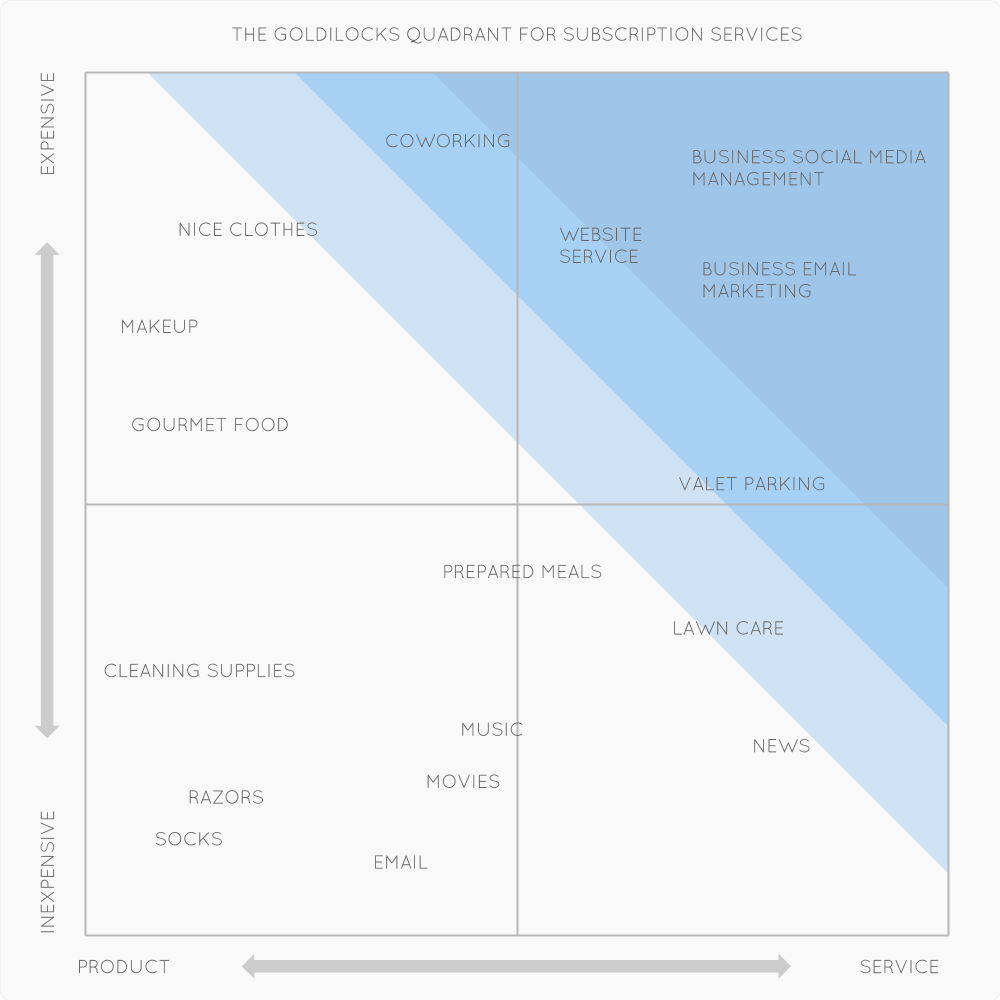
The Goldilocks Quadrant for Subscription Services

As you move into the top right of the quadrant (more like a service + more expensive), you run a higher risk of encountering problems due to the Goldilocks dilemma. It’s also most common to find B2B subscription services in this area, because they’re usually more expensive.

SO, WHAT’S THE PROBLEM?

Firstly, subscription service pricing is inherently unfair. Why? Because in order to make a profit, a company must first cover all their expenses. If a company sells a sock subscription, it will lose money on the picky customers who frequently send socks back for replacement. “These socks are too thin,” they might say.” “And these socks are too thick”. And it will be the reasonable customers, the ones who pull up their damn socks and go to work, that pay for it.

Secondly, subscription services are forced to construct rigid product barriers to control their costs. Customers are sold one-size-fits-all packages, because otherwise you begin to lose the efficiency that underpins your entire business model. Put differently, it’s hard to scale if you don’t constrain your features and service. Again, this unfairly punishes the easygoing customers for the heightened service demands of customers who need more hands-on service. To continue with our metaphor, the bad customers eat all the warm porridge, and the good customers are castigated to the support forums.

Last, but not least, the Goldilocks dilemma leads to high instances of customer churn for the service provider. Because you’re selling a one-size-fits-all service that’s expensive and burdensome to service – customers will take their business elsewhere when their patience is tried too many times. Some companies never solve this problem, and they die. Many “productized” web services companies attempt to solve this problem by hiring tens or hundreds of salespeople to feed more and more meat into the grinder. The reality for these companies is that they don’t build those giant sales teams to grow, they build them to fight churn – their most important metric.

Companies offering subscription services that suffer from the Goldilocks dilemma truly do mean well. They are indeed solving a perceived problem: it’s expensive, time consuming and burdensome to hire a company or individual to provide the same type of service. It’s also hard to find the right one to hire (see our post on finding the right contractor). But in the end, for most customers, these types of subscription services almost always fall short – especially when it comes to higher margin services.

WHAT’S THE SOLUTION?

goldilocks dilemma for businesses

There are lots of ways to address the problems caused by the Goldilocks dilemma: expanded feature sets with different pricing tiers, paid consultations, premium support, etc. These strategies allow service providers to keep costs low for the customers who don’t put a burden on the support staff.

But, some services simply shouldn’t be subscriptions in the first place. If you’re looking for candidates of services that shouldn’t be subscriptions, use the Goldilocks quadrant to find them. Not surprisingly, website service is one of them. We believe on-demand alternatives will displace these subscription services – that’s why we’re launching our new instant website service app.

With the advent of businesses offering subscription alternatives in virtually every product and service market, subscriptions seemed like the way of the future. But, the rapidly emerging on-demand economy will push many subscriptions out of the way. Why pay a monthly subscription for a highly constrained service when you can get the same high quality service instantly, and only pay for exactly what you need?

Gazing at her smartphone screen instead of a bear’s porridge bowl, a modern-day Goldilocks might say, “This subscription service is too expensive…this subscription service is too limited…ahhhh, this on-demand service is just right!”

To learn about our own struggles with Goldilocks, read our Velocity Pricing post.

4 Important Lessons from Mark Zuckerberg

I recently took 30+ minutes to watch this Mark Zuckerberg interview from back in 2013. From running through walls to (…not) pushing up hills, I found some great insights worth sharing on the HubRunner blog.

Really Care About What You’re Doing

It’s interesting to hear Zuckerberg reflect on his early days of building Facebook, before he realized his company was going to succeed in connecting billions of people. He says, “someone else is going to have more resources [than you do].” In an environment where any number of existing companies with tons of money and human resources could have overpowered Facebook in their goal to connect people…they didn’t. Why not?

“We just cared way more about it than everyone else.”

It seems like classic entrepreneurial rhetoric to talk about succeeding simply because you cared about an issue more than anyone else, but when Zuckerberg qualifies his statement, it makes more sense:

“We just believe really strongly this is what we are here to do. This is what our company cares about. I care about it, the team cares about it, our culture cares about it – so, we’re just gonna keep pushing on it. And, I actually think a lot of the reason why great stuff gets built is because it’s kind of irrational at the time, so it kind of selects for the people who care most about doing it.

Keep Running Through The Walls

This point is incredibly important because it’s just so easy to get discouraged when you’re building a company and a product. Zuckerberg sums it up succinctly:

“You just have to keep running through the walls.”

In our own experience, as soon as we solve a problem or overcome a challenge, inevitably there’s another one waiting just around the corner. It’s important to get comfortable with that reality, because if each new challenge gets you down, you’ll be down all the time. So, accept that the process of building a company is going to be a constant stream of challenges, and teach yourself to thrive in that environment.

“So many things go wrong when you’re starting a company…Don’t even bother trying to avoid mistakes, because you’re going to make tons of mistakes. The important thing is actually learning quickly from whatever mistakes you make, and not giving up.”

Don’t Push Uphill

In our years as entrepreneurs, we’ve spent so much time, energy and resources pushing heavy things uphill: we’ve worked incredibly hard to sell products that not enough people really wanted, or that weren’t the right fit for the market. Instead, it’s important to think deeply about what people really need – what they really want – and to build your product accordingly.

“You can’t push uphill on this stuff.”

Instead,

“We built a lot of tools to enable people to do what they already wanted to [do]…We were solving a problem that people had, and we just needed to remove as much friction as possible.”

Build Something that Resonates

Zuckerberg talks about his focus on “channeling a community’s energy to build some kind of shared asset.” This focus helped him create early products like course graph and, later, Facebook. In the interview, he says that people building products should,

“Build something that resonates with everyone on the planet.”

Even if you’re not creating a product to be used by every person on the planet – for example, in the context of building B2B products – this insight is still useful because it helps keeps you honest. What’s the real potential of your product? What’s the potential market? Does what you’re doing matter enough, to you?

Asking and answering these tough questions can take you back to the first insight discussed above:

“You can win if you care more about an issue than anyone else.”

What We Care About

So, at HubRunner, what do we care deeply about? We care deeply about fixing the broken website industry, and you can see our earlier post, “The Problem with the Website Industry” to learn more.

What do you care about? Feel free to share a thought and a link below.

The Problem With The Website Industry

The website industry is broken. It’s inefficient, outdated, wasteful and frustrating. From domains to design, from service to search engine optimization – today’s website industry is built on a foundation of complexity and misinformation that capitalizes on website owners’ lack of knowledge and desperation for help.

This imbalance leads to inflated prices that gouge America’s businesses and nonprofit organizations. It leads to massive amounts of wasted time, wasted energy and unnecessary frustration. Most importantly, it leads to bad websites.

Digital Snake Oil

The signs of manipulation are everywhere. Just moving through the process of buying a domain on GoDaddy, by far the largest domain name registrar, is scary and complicated, with numerous upsells manipulated to appear as if they’re indespensible or even mandatory.

Even worse, try navigating the ecosystem of website-related services that target small businesses: chock-full of A-type salespeople hell bent on selling you a subscription no matter how nebulous the service or how much (or little) you actually need it. The reviews of these services – from social media management to email marketing – read like a small business owner’s nightmare.

And that is all assuming you’ve been able to get a website in the first place. We all know people who’ve worked with a “website developer,” only to be abandoned before anything made it live on the web. There are some decent DIY solutions, like Squarespace (and some not-so-decent DIY solutions, like Wix) but the reality is that most site owners spend loads of time and still don’t end up with good results.

The Wrong Solution

Three years ago, we thought the solution to the broken website industry would be a crystal clear, all-inclusive subscription service ranging from about $100 to $300 per month, wherein website owners would receive everything they needed to get a great website upfront, and then they’d receive all the service and support they needed to have a great, fully-managed website on an ongoing basis.

As our customer base grew, it became clear that while this solution works well for some people (like lawyers, dentists, therapists, etc.), it’s definitely not a solution that will solve the above-described problem on a large scale.

What’s needed is a major shift in the market, a completely new system of distributing website service that renders today’s digital snake oil salesmen unable to continue clawing money out of people’s pockets.

A 10X Improvement

By way of comparison, the transportation industry recently began undergoing a significant market shift. Using taxi cabs is a nightmare: they’re difficult to find, unpredictable, expensive, and they generally provide a terrible service experience. Uber and Lyft introduced products that are not just incrementally better, they’re 10X better.

As Peter Thiel writes in his bookZero to One,

“Only when your product is 10x better can you offer the customer transparent superiority.”

The Right Solution

We know the website industry is broken. And that means the experience of getting and having a website is broken, too. Back in the Fall of 2015, we focused on this experience – on what’s wrong with it, and on what people desire – and it didn’t take long to begin visualizing the solution.

Like Uber and Lyft, we need a website service system that transparently delivers exactly what people need, when they need it, at fair prices. As soon as we saw this, we immediately knew we had to build it.

So we did.

What we’ve built is a web-based platform that seamlessly connects people who have and need websites, with people who want to service and build websites in real time. Our software elegantly eliminates the major problems that exist in today’s website industry. All of this is gone: searching for freelancers, vetting their abilities, sharing login credentials, getting estimates, negotiating prices, email chains, uncertainty about getting what you ask for, uncertainty about how much you will pay, paying too much, leaving login credentials in a stranger’s hands, and, perhaps most importantly, dreading the next time you need something done on your website.

Through our software, we believe the impact of being able to get anything done to a website immediately – by pulling your phone out of your pocket and ordering whatever you want – will be dramatic, and will open up new possibilities for website owners and for website service providers.

As we publish this blog post at the beginning of 2016, we’re still improving HubRunner and testing it with our early users. We are so excited to bring you this product, because we believe that together we can change this industry for the better, forever.

So, join us as a user! Or, if you know WordPress, become an agent!

We can’t wait to get your feedback.